It is a rare ocassion to receive the fruit of scholarly research on ministry at the margins of power. Hartness M. Samushonga provides readers with wisdom from years of research and theological reflection on a form of church leadership that just might be the key to revitalizing Christianity in the global North. I highly recommend his most recent book, Critical Perspectives on Bivocational Ministry: Practice, Education and Research.
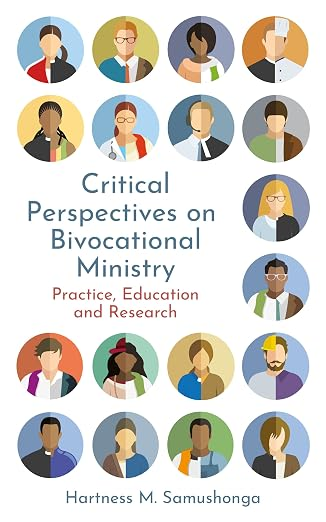
“Critical Perspectives of Bivocational Ministry offers a comprehensive, original exploration of the theological, biblical, educational and practical dimensions of bivocational ministry across the United Kingdom, the United States, Canada, and Africa. Grounded in Scripture and developed through Practical Theology, Samushonga shows how dual-vocational calling complements traditional full-time ministry, enriching the Church’s understanding of vocation, mission and service.”
Critical Perspectives on Bivocational Ministry: Practice, Education and Research by Hartness M. Samushonga. SCM Press, 2026. ISBN: 9780334061328.
From the Foreword:
Critical Perspectives on Bivocational Ministry: Practice, Education and Research arrives at a kairos moment for the church. In this book, Hartness M. Samushonga provides a deep exploration of ministry, ecclesiology, and vocation, drawing on his experiences as a Pentecostal pastor in Zimbabwe and England. He writes from the vantage point of diasporic and immigrant communities, in conversation with the history, theology, and development of bivocational ministry. A practical theologian, he indeed “affirms bivocational ministry not as a compromise, but as a legitimate, dynamic, and Spirit-empowered vocation.” Herein lies practical wisdom from a pastor-scholar reflecting on the praxis of ministry in all its complexity.
Practical theology is disciplined reflection on the lived experience of faith for the purpose of deepening our understanding of God and living more faithfully. Far from a secondary intellectual endeavor, practical theology provides the primary means of understanding an incarnate savior embodied within a human community that claims itself to be “the body of Christ” (1 Corinthians 12:27, NRSVUE). Sophisticated loci of systematic theology, such as ecclesiology and missiology, are thus derivative rather than definitive of ministry praxis. Rather than limiting the possibilities of God’s inbreaking Spirit to the confines of human wisdom, practical theology expands our understanding of Christian ministry and life in relation to God and each other.
Samushonga is a deeply reflective leader who proves an able guide to this Spirit-led practice. He uses the tools of practical theology to good effect, noting the integrative value of serving in both “sacred” and “secular” vocations, and is surely correct that “embodied reflection on ministry in the midst of diverse vocations challenges churches and theological institutions to reframe ministry as a dynamic, multifaceted, and community-embedded vocation rather than a monolithic professional identity.” Eschewing demeaning characterizations and definitions based on deficiency in relation to the prevailing full-time model, he seeks an inherently theological identity for bivocational and multivocational pastors as legitimate and faithful expressions of Christian ministry.
Through his experience of how ministry works in diverse settings, Samushonga brings a unique perspective on the nature of the church and its ministry. His work has relevance for pastors, congregations, denominations, and institutions of theological education. His willingness to learn from African diaspora churches in the United Kingdom as models of faith, leadership, and Christian community should inspire readers: not only to recognize diasporic wisdom but also to consider the unexpected ways that God is showing up in their own diverse contexts. I believe that he has succeeded in his aim, “to offer a comprehensive and critical exploration of multi-occupational ministry that is both theologically robust and practically relevant.” This book furthers a nascent and important discourse on bivocational ministry in the twenty-first century.
Hartness M. Samushonga is a practical theologian, entrepreneur and bivocational minister whose work bridges ministry practice, theological research, and healthcare leadership and research. He is a contributor to the edited volume, Bivocational and Beyond: Educating for Thriving Multivocational Ministry.